For children aged 4 to 9, space is one of the most captivating topics that sparks the imagination. Illustrated books and encyclopedias often become the first window into this magical world—turning pages together with their parents, little ones learn to dream and marvel at the stars and planets. Books truly awaken a curiosity that nothing else can replace.
However, it is difficult for preschool children to grasp invisible space and true scale solely from the pages of a book. As Swiss psychologist Jean Piaget observed, children of this age are in the so-called preoperational stage of cognitive development: their understanding of the world is based on what they can directly touch, walk around, or see with their own eyes. Therefore, phrases about "billions of kilometers" or flat pictures of orbits in a book are still far too abstract for a five-year-old. To make the stories found in books truly understandable, it is best to supplement reading with spatial, tactile exploration and simple, everyday discoveries.
The Challenge: From an Image on the Page to a Sense of Space
According to Piaget’s developmental theory, the ability to mentally transform a flat 2D illustration into a moving 3D system develops much later. When looking at a picture in a book, children often assume that the planets simply sit in a stationary row next to each other.
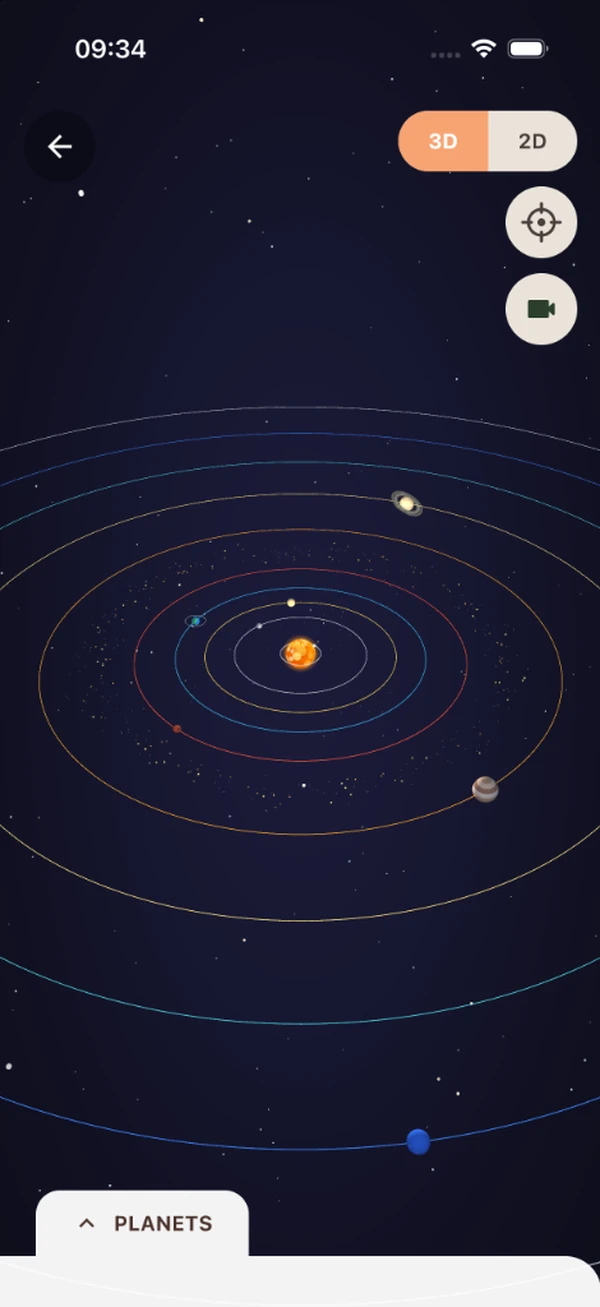
However, when a child can spin a planet with their finger, observe its tilted axis, and compare how close Mercury orbits the Sun relative to distant ice giants like Uranus or Neptune, the brain connects motion with meaning—and the underlying concept clicks.
In Montessori education, complex topics are broken down into clear, experiential steps—isolating a single concept so as not to overwhelm the child’s focus. Instead of starting with the laws of gravity or distance charts, let them experience the fundamentals: first, the Sun at the center; next, the planets traveling around it; and finally, Earth’s rotation creating day and night.
3 Essential Steps to Discovering the World of Planets
1. The Sun — Our Cosmic Anchor
Help your child imagine the Sun as a vast, warm center holding the entire family together. Everything in our solar system moves in an orderly dance because the Sun’s invisible pull gently keeps the planets along their paths. Spark their curiosity with a question: “What do you think keeps Earth from simply drifting away into the dark infinity of space?”
2. Two Families of Planets: Rocks and Giants
Divide the planets into two easy-to-remember groups:
- Four rocky neighbors (Mercury, Venus, Earth, Mars): Solid worlds of rock and metal where explorers or rovers could land and leave a footprint.
- Gas and ice giants (Jupiter, Saturn, Uranus, Neptune): Colossal worlds of storms, swirling vortexes, and icy rings, with no solid ground to stand on.
3. Planetary Rotation and the Child’s Daily Rhythm
Every child naturally senses when the sun rises in the morning and when bedtime arrives. Connect this rhythm to the cosmos: when Earth turns to face the Sun, the outdoors lights up and daytime begins; as we slowly rotate away into the shadow, stars light up the sky and nighttime arrives.
How “Little Discoveries” Unlocks the Secrets of Space
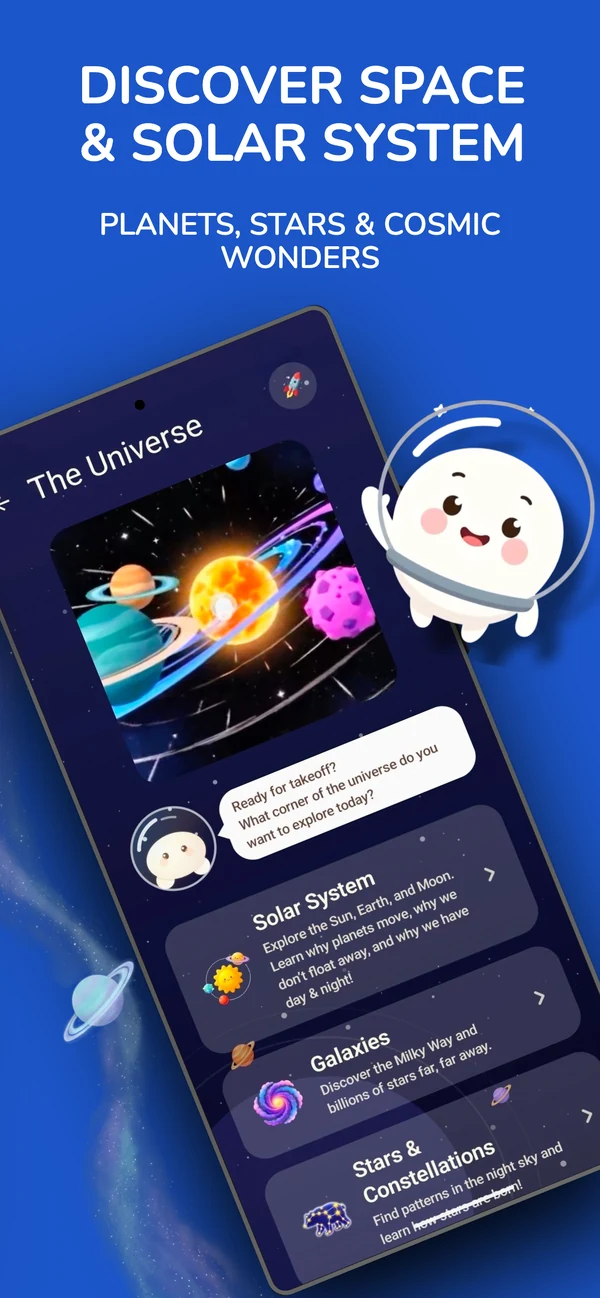
The Universe module in the Little Discoveries: Kids Learn app is completely free:
- Interactive exploration: The freedom to rotate, zoom in, and explore planetary surfaces up close.
- The interplay of light and shadow: A rotating Earth helps children grasp the cycle of day and night.
- Friendly voiceover in English: Every topic is narrated aloud, allowing children to discover answers independently without needing adult assistance.
- 100% safe and calm: Zero ads, no stress, and no race for points.
At-Home Experiment: Moon Craters from Flour and Cocoa
Bring space discoveries right to the kitchen table with a simple yet fascinating experiment:
- Prepare the lunar surface: Pour about 3–4 cm of plain white flour into a deep baking tray or wide dish and gently smooth the surface.
- Sprinkle the cosmic dust: Using a fine sieve, dust the top lightly with dark cocoa powder or cinnamon to create a contrasting dark layer.
- Launch the "asteroids": Give your child small balls of different sizes, nuts, or chestnuts, and invite them to drop them from various heights.
- Watch the magic happen: Upon impact, the dark dust scatters outward, revealing the pale flour underneath and creating authentic rayed craters—just like the lunar landscape that formed billions of years ago!
Explore Space Together with Your Child
The Universe module in the app is 100% free. You can find Little Discoveries: Kids Learn on Google Play and the App Store. Professional English voiceover, zero ads, and works completely offline.