For children between the ages of 4 and 9, outer space is pure magic. Yet traditional astronomy textbooks and dry 2D charts often overwhelm young learners with incomprehensible distances, massive numbers, and abstract physics formulas. How can parents and educators make the Solar System intuitive, tactile, and captivating?
The Challenge: Abstract Scale vs. Tactile Comprehension
Preschool and kindergarten brains develop spatial awareness primarily through physical interaction and sensory touch. When a child is told that "Neptune is 2.8 billion miles away," the number is meaningless. But when they can physically drag a planet along its orbital plane, watch it spin on its tilted axis, and see how close Mercury sits to the fiery Sun compared to chilly Saturn, the concept instantly clicks.
In Montessori pedagogy, complex systems are broken down into touchable, isolated steps. Don't start by explaining the entire gravitational constant. Start with: Sun at the center, planets moving around it, and rotation creating day and night.
3 Essential Steps to Teach Planetary Science
1. Start with the Sun as the Anchor
Help children understand that the Sun is our giant, warm cosmic anchor. Everything in our solar system stays in orbit because of the Sun's gentle, invisible gravitational pull. Ask your child: "Why do you think the planets don't just float away into darkness?"
2. Contrast the Rocky Inner Planets and the Gas Giants
Instead of memorizing all eight planets simultaneously, group them into two friendly families:
- The Rocky Four (Mercury, Venus, Earth, Mars): Small, sturdy worlds made of solid rock and metal that you could stand upon.
- The Gas & Ice Giants (Jupiter, Saturn, Uranus, Neptune): Massive, swirling atmospheric giants with rings and deep storms where you couldn't take a single step!
3. Connect Planetary Rotation to Everyday Experience
Every child understands when it is bedtime and when the morning rooster crows. Use this familiar rhythm to explain planetary rotation: when our side of Earth turns toward the Sun, it is daytime; when we turn away into our own shadow, the twinkling stars appear!
How Little Discoveries Brings the Solar System to Life
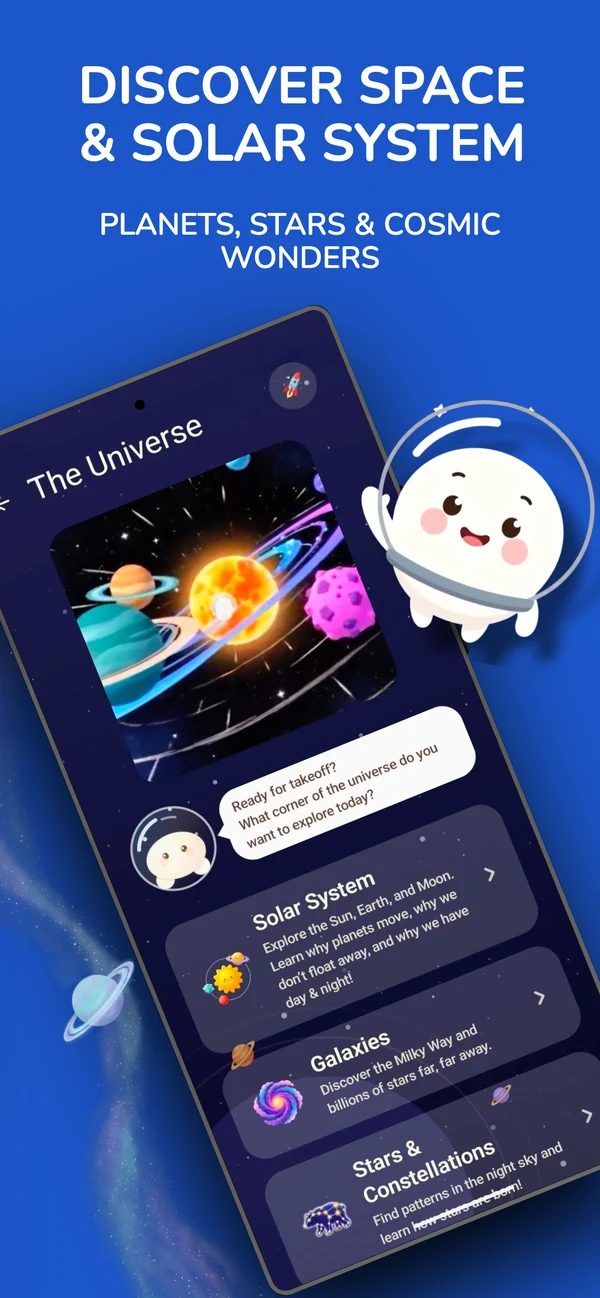
In Little Discoveries: Kids Learn, the entire Universe Module is available 100% free forever. Built specifically with early learners in mind:
- Interactive 3D Perspective Switching: Children touch, pinch, and rotate the solar system in real 3D space, seeing planets from both top-down orbital views and close-up planetary surfaces.
- Day & Night Cycle Simulator: A single tap rotates the planet, illuminating cities and casting realistic planetary shadows.
- Gentle Voiceover in 3 Languages: Spoken audio in English, Italian, and Lithuanian explains astronomical wonders clearly so pre-readers explore independently.
- Zero Overstimulation: No countdown timers, no screaming alarm sound effects, and zero intrusive ads to interrupt their focus.
Screen-Free Extension: The Flour Crater Experiment
Take your child's space discovery straight to the kitchen table with our signature companion experiment:
- Fill a shallow baking dish with 2 inches of white flour.
- Dust a thin layer of cocoa powder or cinnamon over the surface.
- Hand your child small marbles or pebbles (asteroids) and let them drop them from different heights.
- Watch the cocoa dust spray outward in beautiful ray patterns, creating authentic lunar impact craters just like the Moon!
Explore the 3D Solar System with Your Child
The Universe module is 100% free forever on Google Play and Apple App Store. Zero ads, zero subscriptions, 100% offline.